.jpg)
Irmãs Meireles.
Portuguese migration to Brazil was high between 1891 and 1929, when 370,000 Portuguese nationals entered the new republic finding work mostly in the country side.
In the next 20 years - from 1930 to 1950 - only 135,000 Portuguese citizens entered the South American country.
Then, finally from 1950 to 1960 there were 350,000 Portuguese arriving at Brazilian shores. This was the last Portuguese migratory cicle to Brazil. After that Portuguese men and women preferred to migrate to France, USA and other industrialized countries rather than traveling to South America.
So one could say that Sao Paulo had a sizeable Portuguese expat community that needed entertainment. As the Portuguese film industry was not exactly booming in the 1950s, Cine Paratodos, on Rua Santa Efigenia did its best to cater for this market and here are some examples of that effort.
Cine Piratininga, on Avenida Rangel Pestana, 1554 in the inner suburb of Braz, was also a point of convergence of Portuguese migrants who gathered to watch movies made in Portugal.

5 March 1950 - Portuguese movie 'Assim é Portugal' at Cine São José; featuring Irmãs Meireles, Luiz Piçarra, Estevão Amarante, Maria Carmen, Maria Clara, Corpo de Bailes do Teatro São Carlos, de Lisboa, Balet Verde Gaia...
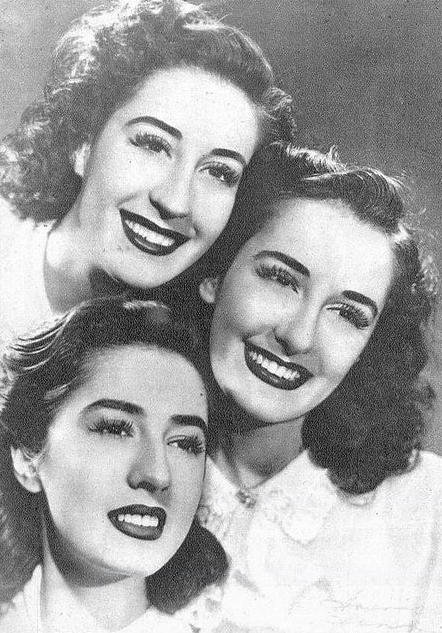
Cidália, Milita & Rosária Meireles in 1944.

2nd March 1952 - a 1948 production of Lisboa Filmes: 'Fado, historia d'uma cantadeira' with Amalia Rodrigues and Virgilio Teixeira.

10 August 1952 - brand-new Portuguese production of 1952 - 'Madragôa' reaches Rio de Janeiro first where - according to the ad - it was a big hit. A love story set in Madragoa, a popular district in Lisbon.

17 August 1952 - a 1948 production 'Serra Brava' is back at Cine Broadway, starring Leonor Maia & Antonio de Souza, directed by Armando Miranda of 'Capas Negras' fame.

22nd November 1953 - Antonio Lopes Ribeiro's 'Frei Luis de Sousa' was released in Lisbon on 21st September 1950.

3 January 1954 - 1938's 'A Rosa do Adro' is back at Cine Paratodos with Maria Lalandre & Oliveira Martins directed by Artur Duarte.
 31 October 1954 - 7 Portuguese movies in 7 days: on Monday, 'Cantiga da rua' (1950) with Alberto Ribeiro; on Tuesday, 'Fado' (1948) with Amalia Rodrigues; on Wednesday, 'Tres espelhos' (1947) with João Villarey; on Thursday 'A Rosa do Adro' (1938); on Friday, 'Frei Luis de Sousa' (1950) with Maria Sampaio; on Saturday, 'Madragôa' (1952) with Deolinda Rodrigues and finally on Sunday, 'A Severa' (1930) with Dina Tereza.
 7 November 1954 - still at Cine Paratodos, 'Cantiga da rua' is back by popular demand. It was the most popular of the seven movies shown the previous week.


10 July 1955 - Portuguese comedy 'Sonhar é facil' (It's easy to dream) directed by Perdigão Queiroga in 1951, with Antonio Silva. Laura Alves & Santos Carvalho; Note the 30-minute short about Brazilian President Café Filho visit to Portugal. Cine Paratodos catered for the Portuguese community living in Sao Paulo.

4 September 1955 - Cine Paratodos puts up a Portuguese film festival showing a different movie each day of the week: Monday: Manuel Guimarães' 'O grande circo' (1951) aka 'Saltimbancos' based on a novel by Leão Penedo wih Helga Line; Tue.: Conttineli Telmo's 'A canção de Lisboa' (1933) with Vasco Santana, Beatriz Costa & Antonio Silva; Wed.: Arthur Duarte's 'O grande Elias' (1950) with António Silva, Miló, Ribeirinho & Amarante; Thurs.: Leitão de Barros's 'As pupilas do Senhor Reitor' (1935) with Joaquim Almada, Maria Matos & António Silva; Fri.: Arthur Duarte's 'O fôgo'(1949); Sat.: Arthur Duarte's 'O Costa do castelo' (1943) based on a play by João Bastos with Maria Matos, Antonio Silva, Milu, Fernando Ribeiro & Tereza Casal; on Sunday:m Arthur Duarte's 'O hóspede do quarto no. 13' (1947) with Tereza Casal, Maria Eugenia & Alfredo Mayo.

6 September 1955 - Portuguese cinema festival at Cine Paratodos; a different movie every single day for a whole week.

.PNG)
2nd April 1956 - Armando de Miranda's 'Serra Brava' released originally in Lisbon on 13 May 1948, with Leonor Maia, Antonio de Souza, Juvenal de Araujo, Arminda Vidal and Sacramento.

6 May 1956 - at Cine Paratodos 'Assim é Portugal', a Brazilian production released in 1947. Director Armando Miranda shows the many Portuguese acts who worked and lived in Brazil in the 1940s like the Meireles Sisters featuring Cidalia Meirelles individually; plus Esther de Abreu, Artur Agostinho & many other singers and combos. This Brazilian production was re-titled 'Aqui, Portugal', when it was shown there.

3rd June 1956 - Arthur Duarte's 'O grande Elias' is back at Cine Paratodos

1st August 1956 - French production shot in location in Portugal 'Os amantes do Tejo' (Les amants du Taje) with Françoise Arnoul, Daniel Gelin and Trevor Howard as Inspector Lewis; Amalia Rodrigues plays herself and sings 'Barco negro' and 'Solidão'.


2nd September 1956 - Catalan director Ignacio Farrés Iquino's 'O Judas' (El Judes) a 1952 Luso-Spanish production. That was the first film spoken in Catalan since the Franco was in power. See also the documentary 'Quem ama Lisboa' where Amalia Rodrigues sings 'A ronda dos bairros'.


23rd December 1956 - at Cine Paratodos a Portuguese double-feature: 1954's 'O cerro dos enforcados' based on 'O defunto', an Eça de Queiroz short-story plus 'Agora é que são elas' advertised as the first Portuguese revue-movie shot on location at Teatro Avenida in Lisbon, featuring Milú and Brazilian bombshell Alzirinha Camargo who sings 'Tejo e Guanabara' introduced by radio compere Pedro Moutinho.
 26 January 1958 - As Rio de Janeiro had a larger Portuguese population 'Quando o mar galgou a terra' directed by Henrique Campos in 1954 was premiered there.


 19 April 1959 - Another Portuguese Cinema Week at Cine Piratininga from 20 to 26 April 1959.
 26 April 1959 - I know this ain't no Portuguese production but it's got Portugal's name on its title: 'As lavadeiras de Portugal' is actually a French comedy directed by Pierre Gaspard-Huit in 1957: 'Les lavandieres du Portugal'.

 15 October 1960 - As late as 1960, Cine Piratininga still showed double-feature Portuguese movies: 'Capas negras' (1947) with Alberto Ribeiro & Amalia Rodrigues plus 'O homem do Ribatejo' (1946) with Julieta Castelo; including 'Roteiro das Cataratas', a Brazilian documentary plus a colossal live show on the Piratininga stage featuring Alberto Ribeiro, Abilio Herlanber, Raul Mota, Sergio D'Avila, Tony de Matos, Alcino Ribeiro, Cidália Meireles, Manuela Siqueira and introducing the movie-star Julieta Castelo.

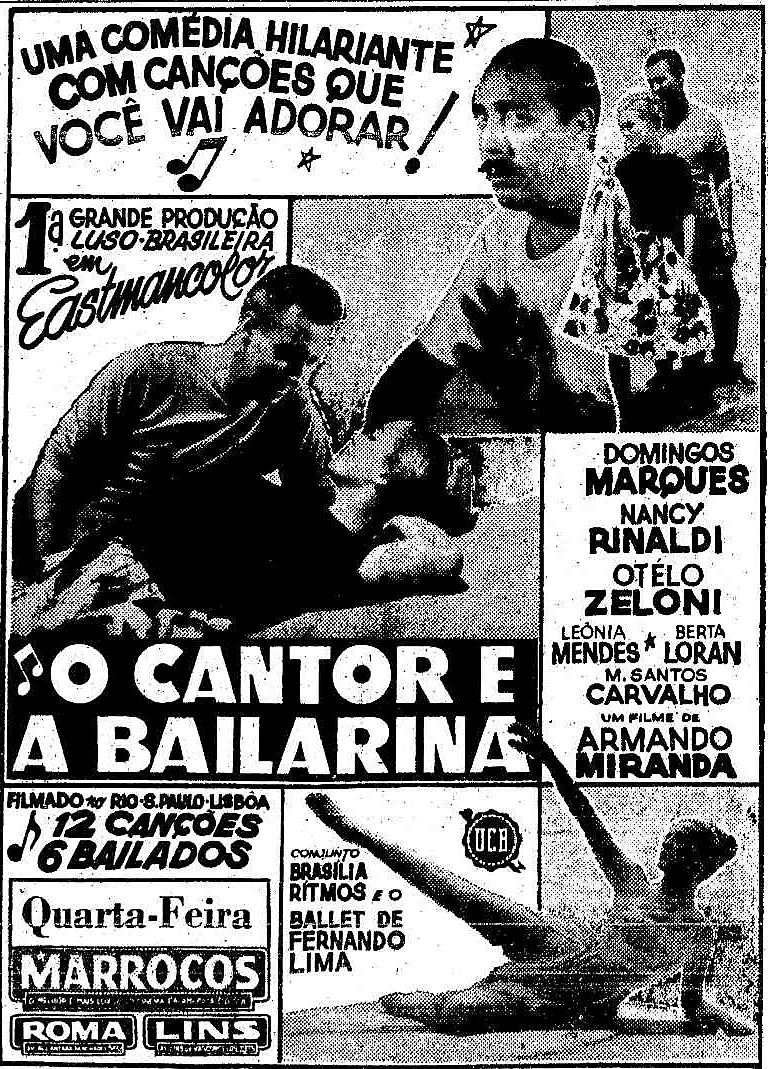
 5 November 1961 - A rare Portuguese-Brazilian co-production 'O cantor e a bailarina'. Unfortunately I do not have more information about it.

14 June 1958 - Franco-Italian co-production 'La meilleure part' (Correntes da violencia); a 1954 British travel short-film narrated by Trevor Howard starring Jocelyn Lane and featuring Amalia Rodrigues singing 'Coimbra' & 'Canção do mar'.


6 July 1958 - dazzling Cine Piratininga on Avenida Rangel Pestana, 1554 in the inner suburb of Braz, was also point of convergence of Portuguese migrants who gathered to watch movies made in Portugal. As the Luso film-industry was not really prolific they usually had to sit through movies they'd seen more than once before. 1954's 'Quando o mar galgou a terra' was actually only 4 years old but 'A mantilha de Beatriz' with Antonio Vilar had been released in 1946.

9 November 1958 - first Portuguese production in MagnaScope, 'O homem do dia'' with Alves Barbosa, Maria Dulce etc.

22 February 1959 - a brand-new Portuguese flick at Cine Piratininga, on Avenida Rangel Pestana, 1554: 'O homem do Ribatejo'; Note 'Canção de Lisboa' as part of the double-featured programme with popular comedienne Beatriz Costa.

Largo do Paisandú circa 1920. As we, unfortunately, do not have a photo of Cine Paratodos, we can only show where it used to be. Follow rua Antonio de Godoy, which starts off next to the darker building on the left-hand-side, It is a one-block street that ends up at the junction of rua Santa Efigenia and rua Casper Líbero. Cine Paratodos was located exactly at this junction.

Well, here's lovely Cine Paratodos...


'Mundo Gráfico' n.133, 30 April 1946, reports on the shooting of 'Um homem do Ribatejo'.


.jpg)


