.jpg)
Marilyn Monroe in 'Something's gotta give', her unfinished opus.

24 March 1963 - I was introduced to 1939's 'Wuthering Heights' ('Morro dos ventos uivantes') by reading this review at Sunday's Estadão. I watched it at Cine Marco Polo and became mesmerized by its powerful images of death and madness. It instantly became one of my favourite movies ever.


'Wuthering Heights' OESP review.

7 April 1963 - George Seaton's 'The counterfeit traitor' (O falso traidor) opens in Rio de Janeiro on 11 April 1963, four months before it reached São Paulo (11 August 1963). I had just turned 14 when I saw it. I was really impressed by Lilli Palmer's role as Frau Marianne Möllendorf who passes information to William Holden's character who works for the Allies. 'The counterfeit traitor' opened in the USA on 17 April 1962. It took a full year to open in Rio which was considered habitual then.
Eric 'Red' Erickson (Holden) is an American-born Swedish oil man who is pressured by Allied intelligence agents, led by a British agent (Griffith), to spy for the Allies. Erickson begins his job reluctantly, as it causes marital discord and forces him to pose as a Nazi. He agrees because otherwise his business would be destroyed by the Allies, but over time, realizes it is the right thing to do.
He is influenced in making this moral decision by one of his contacts in Germany, a religious woman (Lilli Palmer) who gives him guidance on the meaning of life and right and wrong. Erickson has a number of close calls, but eventually escapes to Sweden in a harrowing sea voyage.

Eric Erickson (Holden) and Marianne Möllendorf (Palmer).
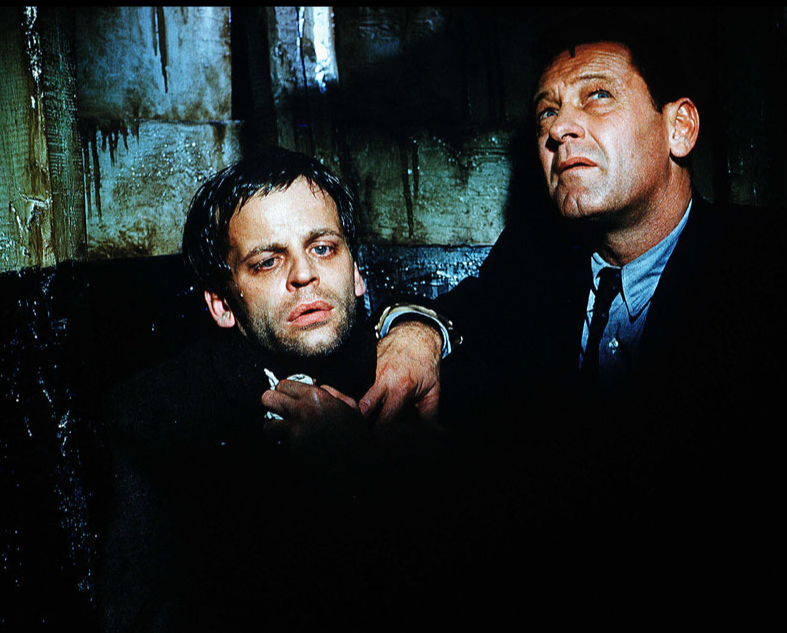
Klauss Kinski plays a Jewish man who flees to Sweden on a boat and chokes to death with a handkerchief stuffed in his mouth trying not to cough and be discovered by the Gestapo.

a Gestapo agent enters the confessionary while Palmer waits for a priest.

the hightlight of the movie is this scene in which the character played by Lilli Palmer confesses her sin - of aiding an American spy - to Unger, a Gestapo agent (Peter Capell) who took the place of a Catholic priest in the confessionary.

'The counterfeit traitor' opened in New York City on 17 April 1962.

.jpg)

7 April 1963 - After watching 'Wuthering Heights' at Cine Marco Polo, I realized there was a wealth of old US movies made in the 20s, 30s & 40s I'd love to be able to see. I kept my eyes open when I read the cinema section of Estadão and I guess this Harold Lloyd's 'World of comedy', a compilation of highlights of his best comedies was perhaps the first I saw. I came out of Cine Bandeirantes in a state of grace. I had been a fan of Charles Chaplin but Lloyd was different; he was modern even though all films had been shot in the teens and 20s.

7 April 1963 - It's funny I did not mange to see either of these 3 flicks. I don't know what my reaction would be to Edward Blake's 'Breakfast at Tiffany's' if I had seen it then instead of watching it on TV in Sydney in the 1990s. Knowing my romantic pench I don't think I would have liked it even though Audrey Hepburn was such a beautiful sight to see and to listen to Henry Mancini's 'Moon River' and all that wonderful sound-track was heaven.


'Filmelândia' with an abstract of 'Bonequinha de luxo' (Breakfast at Tiffany's). It was released in the USA on 5 October 1961. It took 18 months to be released in Brazil on 10 April 1963.
I also missed 'Candelabro Italiano' (Rome Adventure) too. I don't think I knew Suzanne Pleshette as yet otherwise I wouldn't have missed it.
As to 'Se o marido atender... desligue' (If a man answers... don't hang up) with Sandra Dee - whom I really liked - and Bobby Darin - I have no explanation except that I must not have seen the ads or passed by the huge lobby of Cine Ipiranga around that time.


 You never knew if Bella Cortez was going to kill the muscle-man or perform a blow job on the spot.


 Steve Reeves just being gorgeous earlier in his life as Mr. Universe; former Tarzan Gordon Scott & Reeves doing the best grimaces they could muster in 'Romolo e Remo'.


 11 August 1963 - George Seaton's 'Counterfeit traitor' (O falso traidor) was unforgettable to me mainly because of one particular scene. Lilli Palmer is German woman who helps William Holden who plays a Swedish spy for the Allies. She, a Catholic devout feels the need to confess, enters a church and goes to the confessional but instead of a priest there to hear her sins is Gestapo man; Alfred Hitchcock's 'The birds' (Os passaros) was at its 5th week at Cine Paisandu with Rod Taylor, Suzanne Pleshette & Tippi Hedren.
 29 September 1963 - Time was running fast against this kind of Brazilian comedy... Ronaldo Lupo had been a producer, director & actor with many hits on his hands; 'Quero essa mulher assim mesmo' must have been his last try; This is late 1963 and Cinema Novo had been around for a couple of years already... TV was making heavy steps into people's viewing habits... crowds were deserting movie houses by the thousands... Why should one go out and pay money to see something they could easily see by simply switching a button at home? It is emblematic that this flick has got so many of the best of Brazilian 1950s comedies like Violeta Ferraz, Grande Otelo, Renata Fronzi, Hamilton Ferreira who played only bad-men... Times were really a-changing...


 10 November 1963 - Charles Chaplin piece-de-resistence 'Limelight' was re-released for the benefit of those too young to have seen it the first time around some 11 years before, 1952. For those who loved Chaplin, like myself, it was such a treat I can't even describe it; comedian Alberto Sordi had been popular all through the 1950s and still commanded a huge following in 1960's 'Tutti a casa' (Regresso ao lar) at Cine Coral; next attraction would be Jacques Demy's 1961's 'Lola' with Anouk Aimée. The names of the film and title characters were inspired by Josef von Sternberg's 1930 film 'Der bluae Engel', in which Marlene Dietrich played a burlesque performer named Lola Lola; next attraction at Cine Rivoli would be Stanley Kramer's 'Pressure point' (Tormento d'alma) with Sidney Poitier, Bobby Darin & Peter Falk. Kramer had done 'The defiant ones' (Acorrentados) in 1958 with Poitier & Tony Curtis.


7 July 1963 - ‘Forty pounds of trouble’ (20 quilos de confusão) was Hollywood at its fluffiest. Actually it should be called Hollywood visits Disneyland. Suzanne Pleshette was at the peak of her career and Tony Curtis just stumbled from sugary roles in light-weight movies. My young sister Sandra weighed exactly 20 kilos and after proving it by climbing up on a scale at the lobby of Cine Olido was allowed to get in without paying.

7 July 1963 - ‘Diabruras de Marisol’ ('Tombola' or 'Los enredos de Marisol') was the Spanish child star’s 3rd film, made in 1962 when she was still pre-teen; most of epic movies were made in Italy or Spain now: 'Giuseppe venduto dai fratelli' (José vendido no Egito) was an Italian-Yugoslavian production; 'O gigante de Metropolis' (Il gigante di Metropolis) had an American muscle-man and Moira Orfei in the cast. These movies were highly camp with a gay-induced sexuality that was consumed by heterosexuals alike; at Cine Windsor, 'Electra' (A Vingadora).
Marisol's last film as a child; muscle & bust were the staple of homo-erotic-trashy Italian epics.
7 July 1963 - Steve Reeves was the dream of every gay boy in the world. He was an American body builder who after winning Mr. Universe title made Italy his home and starred in dozens of sand-and-sandal movies that were consummed world wide. In 1961's 'Romolo e Remo' aka 'Duel of titans' Reeves is joined by another muscle-man, Gordon Scott who had been Tarazan in a few MGM ficks in the 1950s; at Cine Metro, Steve Reeves is the 'Son of Spartacus'; at Cine Boulevard was 1962's 'Harold Lloyd's World of Comedy' an antology of comedy sequences edited by Lloyd himself, mostly from 'Safety last', 'The freshman', 'Hot water', 'Why worry?', 'Girl shy', 'Professor Beware', 'Movie crazy' and 'Feet first'; at Cine Bijou was 1956's 'Kanal' (Sewer) directed by Adrzej Wajda about the Warsaw Uprising and fighters escaping the Nazi onslaught through the city's sewers; at Cine Majestic was 1939's 'Gunga Din' with Cary Grant.
This was the closest one got to a blow job at the muscle man.

7 July 1963 - Taling about Cary Grant, he was having something of a revival in 1963 with the re-relase of 'Gunga Din' and 'The talk of the town' (...E a vida continua) with lovely Jean Arthur and Ronald Colman; at Marrocos was Robert Youngson's '30 years of fun' (30 anos de alegria) with Chaplin, Buster Keaton, Billy Bevan, Harry Landgon etc. that along with 'Harold Lloyd, o Rei do Riso' and 'Festival de Carlitos' showed to new generations what comedy was like in the 1910s and 1920s.

7 July 1963 - Even though I have never seen 'Joseph and his bretheren' (José vendido no Egito) I can never forget it. My dear aunt Dulce, who' is a Virgo, went to see it and told me every little detail possible about the flick so that it feels like I had seen it myself.

7 July 1963 - Mr Universe meets Tarzan; Steve Reeves plays Romulo and former Tarzan Gordon Scott plays Remo; this was a partnership made in heaven for youngsters who followed Reeves & Scott. I remember the day I went to see 'Romulo & Remo' as if it were today.

14 July 1963 - trying to cash in on Spanish child-singer Joselito's popularity, director Jose Mojica Marins aka Zé do Caixão devises 'Meu destino em suas mãos' (My destiny in your hands) as a vehicle for Franquito, a Paraguyan-Brazilian teen-ager who had already recorded a few albums for Copacabana Records. The ad says Franquito himself would be at the lobby of Cine Europa, on Praça da Republica to sign autographs to his fans.

21st July 1963 - After falling in love with old American movies after seeing 'Wuthering Heights' I used to keep my eyes open whenever I saw movie-ads to see if I spotted them. 'The talk of the town' (... E a vida continua) was my next task. Needless to say I fell in love with Jean Arthur who was already an old lady in 1963. I would only see other Jean Arthur films in the late 80s and 90s but I never forgot her face... and her voice too.

10 July 1963 - Atlantida presents comedians Oscarito, Vagareza & Nair Bello in 'Os apavorados'. This sort of comedy had died circa 1961 of natural causes. Oscarito's use-by-date was long overdue; Vagareza tried hard to become a main-stream comedian with no success; Nair Bello played Dona Santinha successfully on TV sketches but as far as I know never made in the big screen. Brazilian popular cinema had already died - in 1961 - and it would never resurrect...

25 August 1963 - finally, after so much rubbish about the going-ons of drunken stars Liz Taylor and Richard Burton that took almost 2 years here it was: 'Cleopatra' opening at Cine Windsor on 30 August 1963. By that time I had lost interest in the movie and its stars and never watched it either on the big screen or on TV.


Ronaldo Lupo was already 50 years old when he made this comedy... and he was still playing the handsome lead-man... of sorts...
 Violeta Ferraz was still making faces at 60 years old; actually Ferraz could do whatever she wanted... she was too good; see Herval Rossano & Anilza Leoni in the background.


29 September 1963 - a vehicle for Germany's sweetheart Sabine Sinjen (born on 18 August 1942) 'Corações que sonham' (Sabine un die 100 Männer) originally released 1960, featured internationally acclaimed violinist Yehudi Menuhin as himself.


Sabine Sinjen & Yehudi Menuhin in 1960; Menuhim in 1937.


3rd October 1963 - Marilyn Monroe died on 5 August 1962. She was 36 years old and knew her time in Hollywood was through. Her last hit had been Billy Wilder's 'Some like it hot' in 1959 - three long years before which in Hollywood was an eternity. Marilyn had been dumped by 20th Century-Fox when she started arriving late for 'Something's got to give'. Suddenly she had a lot of time with nothing to do so she took a few extra sleeping pills and never woke up. Marilyn may have been a 'has been' with a 'use-by-date' overdue but after her death her image suddenly acquired new life and Fox knew it had a treasure on its film archives, so they told Rock Hudson to be an MC and present a documentary to be released before the 1st anniversary of MM's death on 18 April 1963.


Marilyn & Rock Hudson at the Golden Globe Awards ceremony on 5 March 1962.


27 October 1963 - Ten years after being shown in Brazil 'Limelight' (Luzes da ribalta) is re-released at Cine Rivoli. I had the supreme luck to have seen it and fell in love with it for the rest of my life; at Cine Astor: 'My geisha' (Minha doce gueixa), an obvious vehicle for Shirley McLaine's vanity. She had to have Yves Montand too (Marilyn Monroe had had him in 'Let's make love' in 1960).

3rd November 1963 - Chaplin's masterpiece 'Limelight' (Luzes da ribalta) first shown in São Paulo in July 1953, at Cine Art Palacio and Cine Opera returns now at Cine Rivoli.
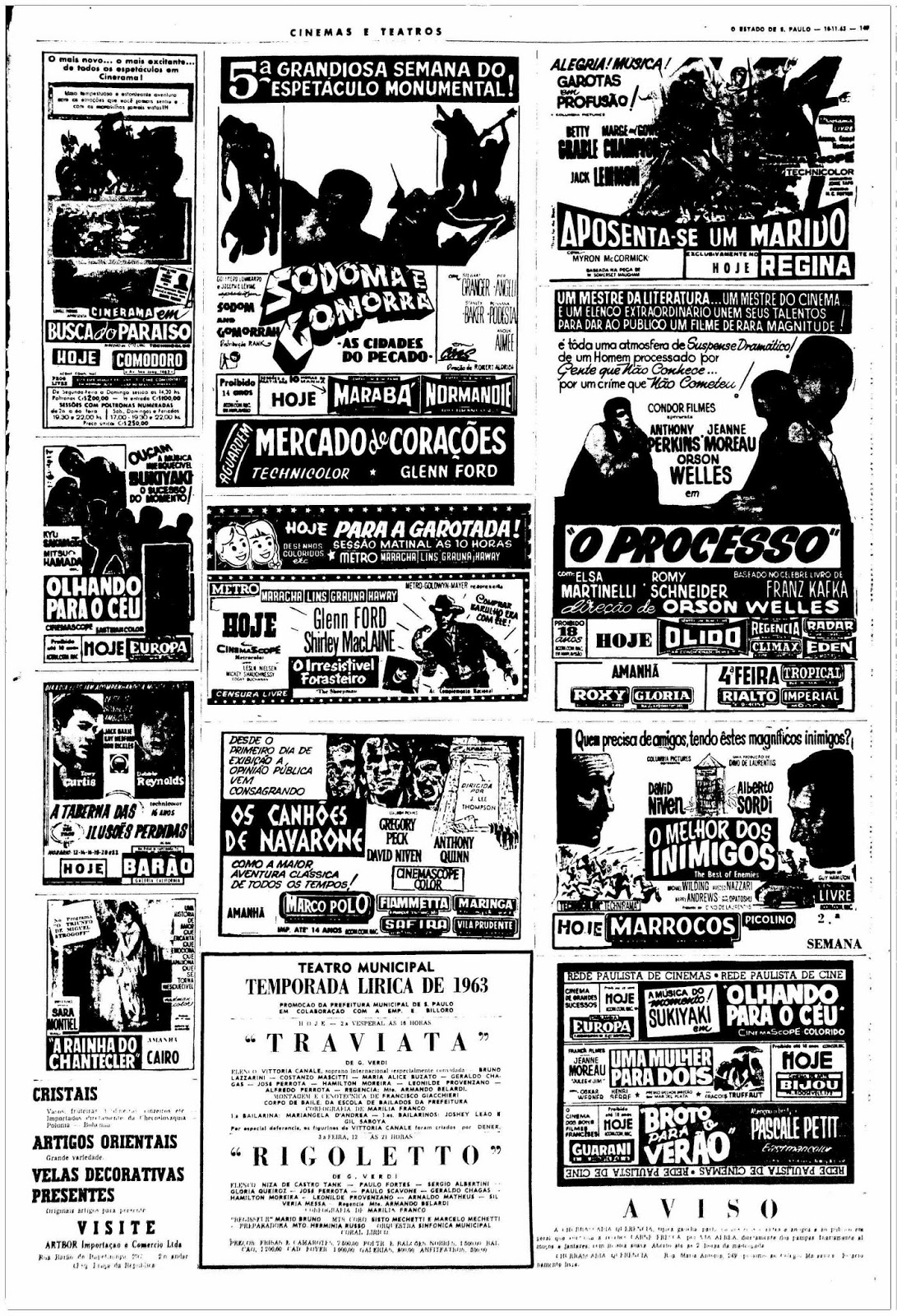
10 November 1963 - At Cine Europa Toshio Masuda’s 1962’s ‘Ueo muite aruko’ (Olhando para o céu) based on Kyu Sakamoto’s song of same name which went to #1 in the USA with the quaint title of ‘Sukiyaky’. Mitsuo Hamada plays the romantic part to Kyu Sakamoto; following the torrent of biblical epics, 'Sodom and Gomorrah' is only another piece or trash with a grey wooden Stewart Granger, a tormented Pier Angeli and an out-of-place Anouk Aimée; at Cine Marrocos 'The best of enemies' (O melhor dos inimigos) with Italian comedian Alberto Sordi playing opposite British David Niven.
Sidney Poitier & Bobby Darin in 'Pressure point'; future detective Columbo, Peter Falk & Poitier.

12 November 1963 - Sarita Montiel sang at Teatro Record and 'Sublime melodia' aka 'Pecado de amor' was shown at Cine Rio, Cine Atlas and Cine Pigalle; 'Lawrence of Arabia' won 7 Academy Awards and was at its 2nd week at Cine Rio Branco; Ronald Golias & Grande Otelo starred in 'O homem que roubou a Copa do Mundo' at Cine Art Palacio & Circuito Serrador; Cine Olido showed Franz Kafka's 'The trial' (O processo) with Anthony Perkins, Jeanne Moreau, Romy Schneider & Orson Welles; Shirley McLaine could be seen in MGM's 'The sheepman' and at Cine Astor & Cine Ipiranga in 'My geisha' (Minha doce geisha) with Yves Montand.

24 November 1963 - a brand-new trash-cinema opens on Avenida Rio Branco, 49 - Cine Arizona was opened to the public on Thursday, 28 November 1963, with 'Jim das Selvas' (Jungle Jim) a movie released 15 years earlier - in 1948. Cine Arizona had a long career until it changed its name to Cine America... only the flies were new for the same old shit. As the 1970s progressed the the city of São Paulo entered a decadence that until today (2017) has not find a way to reverse its rot. Now the whole area stinks of shit, urine, body odor and all...

22 December 1963 - I don't really remember how popular British comedian Norman Wisdom's films were in Brazil. As one can see 1955's 'Norman, um sujeito de sorte' (One good turn) shot in in England 8 years before had a major release in Brazil in 1963. When I pointed out about Norman's popularity in Brazil to my friend John Napper, he wrote at Facebook:
I was not aware that Norman Wisdom's films were known in Brazil. However, his slapstick style was reminiscent of silent films so the visual side would work in any language and he always played the little man fighting against the big organizations which would go down well I think.
He was incredibly popular in Albania because his films were just abouth the only films from the West that were allowed to be shown. He was considered to be innocuous and the Communist authorities liked the way he fought the big Capitalists such as in 'The early bird' where he plays a milkman working for a small dairy that a huge national company was trying to put out of business.
A few years ago, the England football team played a World Cup qualifier in Albania and Norman made a personal appearance on the touch line before the match. The crowd went wild and the England players couldn't understand what was going on!
One more thing that I admire about Norman Wisdom. In his later years he moved to the Isle of Man which many successful people do to avoid income tax. Norman was very adamant that he lived there because it was like England in the 1950s and he liked that. However, he insisted that all his income was declared in the UK and he paid full income tax on it because he still received more than enough to live on comfortably and felt he should pay his fair share. He came from a very poor background and never forgot that. He didn't think it right that he should avoit paying tax just because he had worked hard and become wealthy as a result. I admire that. John Napper, Rio de Janeiro, 22 January 2017.
30 December 1963 - Brazilian actress Norma Benguel 'made it' in Italy being the female-lead in 'Mafioso' directed by Alberto Lattuada with Alberto Sordi.

.jpg)


.jpg)


.PNG)
.jpg)


