Monday, 18 February 2019

1 9 5 4 - January to June - 'Nem Sansão nem Dalila' / 'Gycklarnas Afton' / 'Shane'

Oscarito as Sansão & Eliana as Dalila.
3rd January 1954 - a 1938 Portuguese production 'A Rosa do Adro' is back at Cine Paratodos with Maria Lalandre & Oliveira Martins directed by Artur Duarte.
27 December 1953 - 1952 Warner Brothers' remake of 1929 'The jazz singer' (O cantor de jazz) - now the hero (Danny Thomas) has been fighting commies in Korea. I wonder what sort of role did marvelous Peggy Lee play in this obviously forgettable flick.
3rd January 1954 - movies dealing with Africa and its wildlife had been popular since the beginning of Hollywood mode of mass production. Johnny Sheffield who started as Boy at Johnny Weismüller's Tarzan movies graduated as Bomba - a half-savage teenager who goes around half-naked which was sure to be popular with the crowd. 1951's 'The lion hunters' (Caçadores de leões) was Sheffield's 5th time as Bomba... he would still make another 7 more flicks as Bomba.
17 January 1954 - at Marabá & Ritz 1952's 'Balança mas não cai' with Paulo Gracindo playing the rich cousin & Brandão Filho playing the poor relation; singers Marion and Rogeria do the musical numbers; at Cine Jussara Mexican bombshell Miroslava plays 'Mulher da rua' (Street woman) for the 4th week.
Carlos Alberto plays the football player referred in the title. 
21st January 1954 - Thursday - José Carlos Burle's 'O craque' with Carlos Alberto playing the football crack, Eva Wilma, Herval Rossano, Liana Duval and Burle playing a part too. At Cine Coliseu, in Santos-SP. 
25 January 1954 - the day São Paulo becomes 400 years old, Vera Cruz presents Mazzaroppi in 'O Candinho', based on Voltaire's 1759 ouvre 'Candide'. 
7 February 1954 - legendary Atlantida company's 'super-production' 'Nem Sansão nem Dalila' (Neither Samson nor Delilah). See the schedule followed by the movie cast: OscaritoElianaFada SantoroCyl Farney, bad-man Renato Retier & director Carlos Manga who would be at the premiere in person at various theatres in town: on Monday, 8 February 1954 they were at Cine Cruzeiro in Vila Mariana at 8:00 PM; at Cine Art Palacio on Avenida São João at 8:40 PM and Cine Opera on Rua Dom Jose de Barros at 10:20; on Tuesday, 9 February 1954 the cast would travel even further distances for they would be at Cine Nacional in Lapa at 8:30 PM, then hurry up to the other side of town: Cine Universo - the largest movie-house in town - at 10:00 and then back downtown at Cine Art Palacio half-an-hour later at 10:30 PM.
Fada Santoro & Eliana in 'Nem Sansão, nem Dalila'. 
21st February 1954 - at Cine S.Bento a Bomba flick 'Caçadores de leões' plus a 1947 Argentine production 'La cumparsita' based on the famous tango, starred by Hugo del Carril; a recent Republic serial: 1952's 'Zombie of the Stratosphere' (Zombie da estratosfera) which was intended to be a follow up to 1950's 'Commando Cody' featuring the rocket-powered flying jacket & helmet introduced in 1949's 'King of the Rocket Men'. Instead, for reasons unkonwn, the hero was renamed Larry Martin. This serial is best remembered today as one of the 1st screen appearances by a 21-year old Leonard Nimoy who plays Narab, one of the three Martian invaders.
Leonard Nimoy & an unnamed fellow-actor playing evil-doers... 
Nimoy as Narab, a Martian invader who wants to H-bomb the earth to get it out of the Sun's orbit.
21st February 1954 - As the Sao Paulo International Film Festival went on - from 12 to 26 February 1954 - the Motion Picture Association of America did their bid and showed as many American movies as possible in the least stretch of time: at Cine Arlequim on Avenida Brigadeiro Luiz Antonio, 1.401. Cine Arlequim would close its doors in the late 1960s and be turned into TV Bandeirantes auditorium and it ended up as an evangelical church in the 1990s.
1st March 1954 - Atlantida presents 'Carnaval em Caxias' with Jose Lewgoy topping the bill with singer-actress Doris Monteiro and show-girl turned comedian Consuelo Leandro in a supporting role. Musical numbers galore with Linda Baptista, Dircinha Baptista, Nora Ney, pianist Bené Nunes, Nelson Gonçalves, Jorge Goulart, Carmelia Alves etc. 
7 March 1954 - at Cine Sao Bento a Republic Pictures double-feature: 'Flame of Barbary Coast' (Cidade dos bárbaros) a 1945 western  with John Wayne & Ann Dvorak; 1944's 'The lady and the monster' (Noite de pavor) a horror movie with Vera Hruba Ralston & Erich von Stroheim; to top it off a 1937 Republic serial: 'Dick Tracy, o detetive' (Dick Tracy) starring Ralph Byrd.
  
28 March 1954 - a little known company Iris Filmes presents 'Paixão tempestuosa' with Jardel Filho and TV pioneer actress Vida Alves. Not much is known about this production. 
Vida Alves & Jardel Filho.
18 April 1954 - at Cine S.Bento a 1946 western 'In old Sacramento' (Destino marcado) with William Elliott & Constance Moore; 'Castelo do monstro' with Erich von Stroheim and a 1940 most excellent Republic serial: 'The mysterious Dr. Satan' starring Eduardo Cianelli as the fiendish Dr. Satan, handsome Robert Wilcox as Bob Wayne and the Copperhead, Ella Neal as the engenue and C.Montague Shaw as the inventor of a remote-control device stolen by Dr. Satan's gangsters. 
9 May 1954 - 1951's 'Hurricane Island' ('Tufão') with Marie Windsor aka as Queen of Bs & Jon Hall plus 1945's 'A thousand and one nights' (Aladin e a princesa de Bagdad) with Cornel Wilde plus 2 more chapters of the Republic serial 'The mysterious Dr. Satan'.
Phil Silvers & Cornel Wilde in 'A thousand and one nights'.
23rd May 1954 - Swedish sensation Ingmar Bergman's 'Noites de circo' ('Gycklarnas Afton' or 'Sawdust and tinsel') that was initially chosen to open Sao Paulo's International Film Festival but was boycotted by the American delegation which made the Festival organizers replace it with 'The Glenn Miller Story' - is finally released commercially at Cine Jussara which didn't bode well. You see, Cine Jussara was considered a 'tainted' movie-house due to most of its films dealing with sex & other forbidden subjects; women (and virtuous men) would avoid the place like the plague.
Harriet Andersson
30 May 1954 - Vera Cruz comedy 'É proibido beijar' (Kissing not allowed) starring Tonia Carrero, Mario Sergio, Ziembinski, Inesita BarrosoOtelo Zeloni and Renato Consorte.
6 June 1954 - Cinemascope in all its splendor in 'The command' (Sob o comando da morte) with Guy Madison, Joan Weldon at Cine Bandeirantes.  
12 June 1954 - George Stevens' 'Shane' translated quaintly as 'Os brutos também amam' (Rough men also are capable of loving) which had been premiered during Sao Paulo's Film Festival in February is finally released commercially. Jean Arthur was 52 when she was chosen for the part by director George Stevens. Miss Arthur hadn't been in a film since 1948 and it ended to be her last performance in the movies. She'd been Stevens' choice because he had directed her in 'The talk of the town' (1942) and 'The more the merrier' (1943). 
27 June 1954 - Alex Viany's 'Rua sem sol' (Sunless street) is an almost utterly forgotten film; three outstanding Brazilian women are featured: Glauce Rocha's first movie starring role, Doris Monteiro who was more of a singer but kept her acting option strong and finally 1954 recording sensation Angela Maria who sings 'Vida de bailarina', probably her best recorded song ever plus 'Rua sem sol' the movie-title.  
27 June 1954 - Cine S.Bento sometimes went as far back as the 1930s: 'Terra de ninguém' (Somewhere in Sonora) was a 1933 pre-Code western with a 26-year-old John Wayne; 'Morto ambulante' (The walking dead) was released in February 1936 with Boris Karloff now at Warner Brothers doing his usual thing; the most recent release in the programme was a 1953 Republic serial: 'Jungle drums of Africa' (Tambores feiticeiros) with Clayton Moore & Phillys Coates. Moore had played The Lone Ranger from 1949-1951 and as a TV series from 1954-1957.
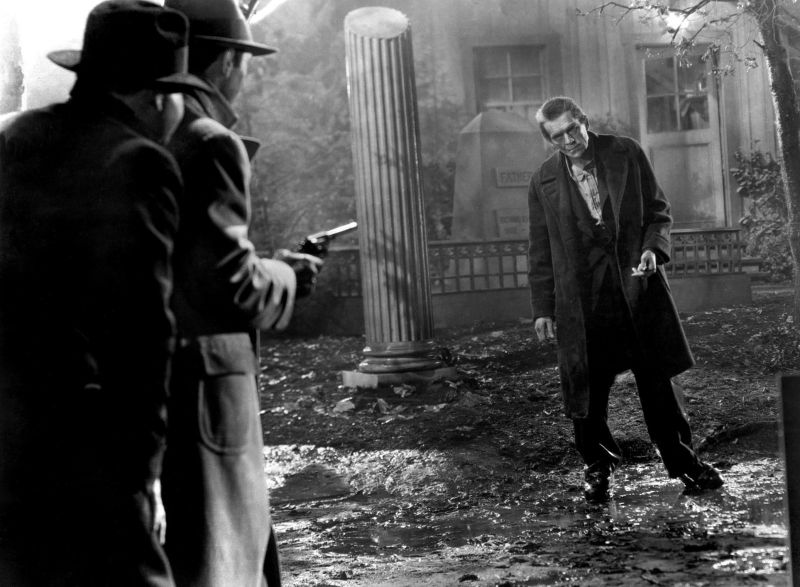
Boris Karloff does 'The walking dead' in 1936.
John Wayne stick 'em up in Sonora in 1933.
Clayton Moore fights the witch doctor in Kenya in 1952.

1 9 5 3 - July to December - 'Limelight' / 'Tim Holt' / 'Os 3 recrutas'


'Esquina da Ilusão' a farse directed by Italian director Ruggero Jacobbi. On the night of 15 February 1952, Dante Rossi, the owner of a canteen in Brás, a working class suburb, ashamed of the terrible economic situation, writes a letter to his Italian brother, in which he claims to be a great industrialist. A year later, the brother decides to visit Brazil. Desperate, Dante decides not to tell the truth and asks fellow immigrants for help. Everyone chips in to support the lie. With the help of Alberto, driver of the capitalist Atílio Rossi, Dante takes on the role of industrialist and starts visiting his factory with his brother. The farce continues until the day Atílio Rossi finds his world tumbling down, with waiters collecting bills consumed by Dante and creditors demanding confirmation of deals undertaken by Alberto. Furious, the real industrialist decides to resolve the situation, but his wife explains the reasons for the farce and convinces him to help Dante and Alberto. Everything ends well with Atílio blessing Alberto's union with Dante's Italian niece, who radiantly continues her work in the Brás canteen." 
12 July 1953 - yet another film from Vera Cruz, 'Esquina da ilusão' with Alberto Ruschel enjoying his stardom after 'O cangaceiro' success; Ilka Soares is the leading lady; see Nicette Bruno in a supporting role.
19 July 1953 - film-noir directed by Russell Rouse 'The thief' (O ladrão silencioso) released in 1952 it didn't cointain any dialogue... only orchestral incidental music of the best quality supplied by composer-conductor Herschel Burke Gilbert. Strong perfomances given by Ray Milland and Rita Gam.
19 July 1953 - Charles Chaplin's masterpiece 'Luzes da ribalta' (Limelight)... the greatest achievement from an artist who was banned by the USA government and denied re-entrance in the country he had lived for more than 50 years.
Charles Chaplin & Claire Bloom at the 'Limelight' premiere in London, in 1952. 
9 August 1953 - 'A virgem de Fatima' (The virgin of Fatima) is not a good title for 'The miracle of Our Lady of Fatima'. A Hollywood version of what happened at Fatima in 1917... three poor young shepherds claimed to have seen a lady on top of a bush that eventually was understood as an aparition of the Virgin Mary herself; at Cine Cairo another religious-based movie: 1949's 'Céu sobre o pântano' (Cielo sulla palude) told a story set in the Pontine Marshes - south of Rome - a disease-ridden region; in 1902, Maria Goretti, a pious 12-year-old country girl was brutally stabbed to death while rebuffing the sexual advances of 18-year-old Alessandro Serenelli. Goretti was canonized by Pius XII on 24 June 1950 after the realese of this. Maria Goretti is played by Inés Orsini who went on to play Lucia in 1951's Spanish flick 'La Señora de Fatima'.
Inés Orsini as Maria Goretti in 1949's 'Céu sobre o pântano'.
9 August 1953 - 'Okinawa', a war film and 1951 'The magic carpet' (O tapete magico) with Lucille Ball just before she turned into a TV celebrity; 1938 Republican serial 'Falcão da floresta' (Hawk of the wilderness) based on the 'Kioga' novel by pulp-fiction writer William L.Chester; Kioga is very similar to the character of Tarzan, whom Herman Brix -  had also played on film in the 1935 Edgar Rice Burroughs-produces serial 'The New Adventures of Tarzan'. Brix's real name was Harold Herman Brix became a silver medallist at shot put in the 1928 Amsterdam Olympic Games. Soon after he moved from Tacoma, Washington to Los Angeles and became a friend of actor Douglas Fairbanks who invited him for a Hollywood test.
2nd September 1953 - Wednesday - Procópio Ferreira stars in Armando Couto's 'O homem dos papagaios' (The man who signed IOUs without thinking of tomorrow) with Lucy Veloso, Waldemar Seyssel aka Arrelia, and heart-throbs Herval Rossano & Helio Souto
13 September 1953 - Vera Cruz's own comedy, 'A familia Léro-Léro' with Walter D'Avila; see Ricardo Bandeira in the cast; he would become really popular as a mimic in the 60s & 70s.
11 October 1953 - the very first coloured-film ever made in Brazil. Helio Souto stars in 'O destino em apuros' with Paulo Autran and Waldemar Seyssel aka the circus clown Arrelia.
29 November 1953 - 'A Tribuna' de Santos - 'O Destino em Apuros' starring Hélio Souto, Waldemar Seyssel, Jayme Barcellos, Beatriz Consuelo & Paulo Autran was the very first coloured film in Brazil. Produced by Mario Civelli; directed by Ernesto Remani.

A little overview of what Brazilian cinema was like in 1953, written by Luiz Carlos Bresser Pereira and published by 'O Tempo'.

São Paulo cinema experienced one of its biggest crisis with the interruption of work at Vera Cruz, and later at Multifilmes and Kino Filmes. From both an artistic and industrial point of view, São Paulo cinema dominated the national market, and, Vera Cruz was on top of  any competitors. 

O cangaceiro” (The bandit), a vigorous film despite some glaring flaws kept the public in tenter-hooks due to its subject matter (banditry) and cruelty. This was followed by a very well conceived comedy, “Uma pulga na balança” (“A Flea on the Scales). “Sinhá Moça”, a superproduction shown in the middle of the year, revealed quite a personaliy in its director Lima Barreto. Italian producer Rugero Jaccobbi showed in “A esquina da ilusão”, an inexpressive little comedy. At the end of the year, Carlos Thiré surprised us with “Luz apagada”, a psychological thriller made with intelligence and good taste.

Rodolfo Nanni's “O sacy”, based on a Monteiro Lobato story managed to please children and adults. Multifilmes released four flicks in 1953: “O homem dos papagaios' (The I.O.U. man),  with Procópio Ferreira; “O destino em apuros' (Destiny in trouble) the very 1st Brazilian colour film, “O craque' (The crack) about a football player (Carlos Alberto) and “Uma vida para dois” (A life for two), none of them really impressive. Pieralise directed “A Família Lero Lero', a weak comedy, the result of a co-production of Vera Cruz and Bandeirantes.

From Rio came Atlântida's “Amei um bicheiro” (I fell in love with a bookie) a detective story shot by Jorge Ileli & Paulo Wanderley; one of the best film made by Atlântida to date. Also from Rio, Alex Viany's "Agulha no palheiro" (A needle in a haystack) and musical comedies like José Carlos Burle's “Carnaval Atlântida”; Carlos Manga's “A dupla do barulho”; Watson Macedo's 'É fogo na roupa', introducing Ankito, a brand-new comedian straight from the world of circus; Eurides Ramos'  “Força do amor” and Luiz de Barros' “Está com tudo”, starring Mesquitinha, Ronaldo Lupo and Mary Gonçalves.  

The biggest disappointment of the year, however, comes from São Paulo, where Alberto Cavalcanti produced “O canto do mar”, an irregular, unbalanced f and deeply pretentious film which became a a major financial failure.  Luiz Carlos Bresser Pereira for 'O Tempo'. 
15 November 1953 - Vera Cruz studios located in Sao Bernardo could do not wrong: 'O canto to mar' produced & directed by Alberto Cavalcanti.
21st December 1953 - Geraldo Vietri's 'Custa pouco a felicidade' premieres in São Paulo; starring Vera Nunes & Paulo Geraldo.  
'Custa pouco da felicidade' was probably the very last Brazilian movie to open in 1953.
11 October 1953 - for the select audience drawn to opera & ballet 'Sinfonia eterna' (Tonight we sing) was a great serve at Marabá, Ritz, Monark and many... Russian ballet diva Tamara Toumanova is featured along side with singer Ezio Pinza, Ann Bancroft et al. 
15 November 1953 - After having made only one film comedian actor Ankito is top billing 'Os 3 recrutas' with Colé, Jose Lewgoy and Adriano Reis. Ankito would make 17 movies in a row until 1961, when this sort of comedy with musical numbers died of natural causes - actually killed by TV for fans then could see their favourite singers on the small screen.
15 November 1953 - French Fernandel playing an Italian priest in 'O pequeno mundo de Don Camilo' ... had an avant-première for the benefit of Sao Miguel Arcanjo church in Jardim Paulista.
RKO's 1950 'Desfiladeiro fatal' 
Richard Martin as Chito Rafferty, the Irish-Mexican comedy relief of Tim Holt
15 November 1953 - RKO's double-feature: 1950 'Horizonte de gloria' (Flying Leathernecks) plus 1950 'Desfiladeiro fatal' (Dynamite Pass) with Tim Holt & Richard Martin; and a 1943 Republic serial 'The Masked Marvel' (Marvilhoso Mascarado) - a hero dressed in a business-suit and a face-mask fights Japanese saboteur Sakima & his espionage organization. In a reversal of the common serial, the audience doesn't know who the hero is until the final reel. Read more about stunt men: http://www.westernclippings.com/stuntmen/tomsteele_stuntmen.shtml
Louise Currie is surrounded by bad men... 
15 November 1953 - Vera Cruz studios located in Sao Bernardo could do not wrong: 'O canto to mar' produced & directed by Alberto Cavalcanti.
Sally Forrest & Keefe Brasselle
13 December 1953 - Oscarito in a 1946 comedy 'Fantasma por acaso'; 1949 'Never fear' (Quem ama não teme) co-written & directed by Ida Lupino with Sally Forest who plays a beautiful dancer with a promising career, struck down with and crippled by polio; see Hugh O'Brien long before he was Wyatt Earp on TV in 1956;  a brand-new Republic serial just released in the USA on 17 February 1953: 'Commando Cody: Sky Marshall of the Universe' (General Cody, o marechal do universo) with Judd Holdren as Cody. 
Herman Brix aka Bruce Bennett as Tarzan in 1935 'The new adventures of Tarzan'. 
with Coca Cola in Guatemala. 
Herman Brix up a tree with Cheetah.