Monday, 18 February 2019

1 9 5 3 - January to June - 'Amei um bicheiro' / 'Sinhá Moça' / 'Undersea Kingdom'

Milton Ribeiro & Alberto Ruschel in 'O cangaceiro'.

I remember watching 'O cangaceiro' (The bandit) when I was really young. I think I was taken to the movies by one of my aunts. I was really scared to watch all those bandits firing their guns at people indiscrimately... 
Humberto Mauro was awarded a 'Saci' for best director of 1953, for 'O canto da saudade'. The trophy was given by daily 'O Estado de S.Paulo'.
11 January 1953 - Spanish production 'La Señora de Fatima' (Senhora de Fatima) released in 1951 in Europe reaches Brazilian shores almost 2 years later; Ines Orsini plays Lucia, one of the 3 poor Portuguese shepherds who purportedly saw the Lady on the bush; Maria Dulce plays Jacinta, the younger sister and Mario Berritúa plays young Manuel; Fernando Rey plays Duarte, the Portuguese government agent.
18 January 1953 - three-quarters of a page of Sunday's 'Estadao' announces Lima Barreto's 'O cangaceiro' as the Brazilian film event of the year. This Vera Cruz production turned out to be one of the most successful Brazilian movies ever. 
15 February 1953 - Vera Cruz's 'O cangaceiro' was picked up by the Brazilian government to be shown at the Cannes Film Festival where it would eventually win as the 'best adventure movie' of the competition. This was the year Brigitte Bardot was introduced to the world.  
15 February 1953 - even though 1953 was just beginning it had already turned out to be one of the best years ever for Brazilian movies. Jose Carlos Burle's 'Carnaval Atlântida' is perhaps the best musical-comedy ever made in the country. It was the culmination of a process started some 15 years before where Atlantida & other companies produced light-comedy interspersed with musical numbers. Brazilian press high-brows were quick to disparage the industry and coined the word 'chanchada' that stuck even though the great public out there didn't give a shit to what the wise guys at the entertainment-sections - known as 'caderno-B' in Brazil - thought. 
15 February 1953 - at Cine S.Bento it was business as usual: a 1949 western 'Rim of the Canyon' (Cidade fantasma) with Gene Autry; a 1951 cloak & sword flick 'Castelo invencivel' (Lorna Doone) with Barbara Hale & Richard Green; to complete the show a fairly recent Republic serial: 1951's 'Rastro do terror' (Don Daredevil strikes again) played by Ken Curtis in a similar fashion as 1944's 'Zorro's black whip'; Don Daredevil was created by Republic to replace Zorro whose rights had been purchased by Walt Disney in 1951. 
15 February 1953 - as late as 1953, Hollywood operetta's darlings Jeanette MacDonald & Nelson Eddy - who were all the rage in the 1930s - were still being shown in the silver screen: 'Bitter sweet' (Divino tormento) released in 1940 was back at Cine Oasis 13 years later.
8 March 1953 - Argentine production of 1948 'El cantor del pueblo' (O cantor do povo) with Roberto Quiroga at Cine Cairo. 
8 March 1953 - 1948's 'Wake of the Red Witch' (O rastro da bruxa vermelha) with John Wayne & Gail Russell; 1948's 'Daughter of the jungle' (Ticoora, Rainha das Selvas) with Lois Hall; plus a 1938 Columbia serial: 'The secret of the Tresure Island' (O segredo da Ilha do Tesouro) with Don Terry & Gwen Gaze; the original story was written by L.Ron Hubbard (future Scientology guru) for a sci-fi magazine; Jubbard wrote the screen-play for the 15 chapter serial. 
Gail Russell & John Wayne in 'O rastro da Bruxa Vermelha'.
Lois Hall as Ticoora aka Tikura in Mexico.
setting up a scene for Columbia's 1938 serial 'The secret of the Treasure Island'.
Walter Miller in 'The secret of the Treasure Island'.
15 March 1953 - Paramount western released in the USA on 1st December 1951, 'Silver City' (Prata maldita) stars Yvonne De Carlo plays Candace Surrency the daughter of a silver miner's owner.
'Correio da Manhã', 27 January 1953; 
15 March 1953 - Watson Macedo's 'È fogo na roupa' in which Ankito is introduced as a new athlete-comedian. 'Correio da Manhã' caption states wrongly Heloísa Helena's hairdresser is Ankito, which is not true. 
15 March 1953 - At luxurious Copacabana Hotel's Plaza night-club Sylvio Caldas serenades Rio's upper middle class every night while Djalma Ferreira e seus Milionários do Ritmo accompany 'lady crooner' Helena de Lima who would get to the top of the entertainment world only in 1965.
15 March 1953 - Rio de Janeiro daily 'Correio da Manhã' full-page ad showing the Arches of Lapa in the background... 
20 March 1953 - Actor Carlos Alberto tells 'Correio da Manhã' all about his biographical background, his half German heritage ... Carlos Alberto Scheff Soares was born in Arroio Grande-RS on 11 June 1925. His mother's sister Esther Scheff who died in 1932, when he was only a child, left a trove of poetry that were cherished by himself and his mother who also wrote poetry. After graduating at Ginasio Pedro II, in Arroio Grande, he traveled to the USA and enrolled at Michigan University where he became a doctor in literature. 

At Michigan University he had a small part in the Canadian playwright Morris Panych's play 'The trespassers' and never left the stage. He got leading roles at Uni's Spanish-language  Shakespeare's plays like 'Sueño de una noche de Agosto', Gregorio Martinez Sierra's 'Rosina es frágil', Vital Axe's 'Zaraguela', Alvarez Quintero brothers' 'Nuestra Natacha', Alejandro Casona's 'La sirena varada' and Jacinto Benavente's 'Los intereses creados'.
Carlos Alberto & Eva Wilma in 'O craque'.
12 April 1953 - directed by Jorge Ileu in 1952, 'Amei um bicheiro' starring Eliana Macedo is back in town just to help Eliana, her husband Renato Murce and Adelaide Chiozzo to draw audience to 'Constelação' a musical revue at Teatro Santana (see ad below).
12 April 1953 - 'Uma pulga na balança' directed by Luciano Salce, starring Waldemar Wey, Gilda Nery, Paulo Autran, John Buckup later aka John Herbert, Lola Brah, Vicente Leporace & Eva Wilma. The article about it on Estadao says: art direction by (Italian) Fabio Carpi, directed by (Italian) Luciano Salce, incidental music by (Italian) Enrico Simonetti and photography by (Italian) Ugo Lombardo. As one can see Italian film technicians fled Italy as Fascism was vanquished by the Allied Forces in 1945 and found employment in Argentina, Brazil and other South American countries. Most of these highly competent professionals - you could call them the Italian Diaspora - went back to Italy in the late 1950s and early 1960s.
'A Família Lero Lero' (1953), directed by Alberto Pieralisi. Shot at the studios of Cia. Vera Cruz at São Bernardo do Campo and locations in Guarujá. Starring Walter D'Avila, Marina Freire. Summary: Aquiles Taveira is a bad-tempered public servant who is taken advantage of by his wife and 3 adult children, Teteco, Janjão and Laurita. He's got no respect from either his neighbours or co-workers. After seeing his children squander his savings, Aquiles allows himself to be accused of embezzling 50 thousand cruzeiros from the office and flees to Guarujá, where he stays in a hotel and tries his luck at roulette at the adjacent casino.

'Esquina da Ilusão' a farse directed by Italian director Ruggero Jacobbi. On the night of 15 February 1952, Dante Rossi, the owner of a canteen in Brás, a working class suburb, ashamed of the terrible economic situation, writes a letter to his Italian brother, in which he claims to be a great industrialist. A year later, the brother decides to visit Brazil. Desperate, Dante decides not to tell the truth and asks fellow immigrants for help. Everyone chips in to support the lie. With the help of Alberto, driver of the capitalist Atílio Rossi, Dante takes on the role of industrialist and starts visiting his factory with his brother. The farce continues until the day Atílio Rossi finds his world tumbling down, with waiters collecting bills consumed by Dante and creditors demanding confirmation of deals undertaken by Alberto. Furious, the real industrialist decides to resolve the situation, but his wife explains the reasons for the farce and convinces him to help Dante and Alberto. Everything ends well with Atílio blessing Alberto's union with Dante's Italian niece, who radiantly continues her work in the Brás canteen." 
'O caminhante solitario'.
 
17 May 1953 - 'O caminhante solitario' (Rough riders of Durango) a 1951 western starring Allan 'Rocky' Lane; 1951's 'Aventuras do Capitão Fabian' (The adventures of Captain Fabian) with an ageing Errol Flynn, Agnes Moorehead & Vincent Price; Republic 1936 serial 'Undersea Kingdom' (Imperio Submarino) starring Ray 'Crash' Corrigan was terribly camp when that word wasn't used yet; as you can see by the photos below not even a gay director like John Waters could devise such a cheap miscelaneous of homo-eroticism.
This robot - with minor alterations - would be used again in Republic's 1940's 'Mysterious Dr. Satan'; read more about him at: http://memory-alpha.wikia.com/wiki/Satan's_Robot  
17 May 1953 - another Vera Cruz super-production: 'Sinha Moça', directed by Tom Payne,starring Anselmo Duarte & Eliane Lage.
19 May 1953 - Vera Cruz does it twice in a row; it breaks all box-office records during its 1st week at Cine Bandeirantes & Cine Joia; 1953 was Vera Cruz best year ever.
31st May 1953 - Sunday - Tom Payne's 'Sinhá Moça' plays at the Roxy in Santos-SP;

1 9 5 4 - January to June - 'Nem Sansão nem Dalila' / 'Gycklarnas Afton' / 'Shane'

Oscarito as Sansão & Eliana as Dalila.
3rd January 1954 - a 1938 Portuguese production 'A Rosa do Adro' is back at Cine Paratodos with Maria Lalandre & Oliveira Martins directed by Artur Duarte.
27 December 1953 - 1952 Warner Brothers' remake of 1929 'The jazz singer' (O cantor de jazz) - now the hero (Danny Thomas) has been fighting commies in Korea. I wonder what sort of role did marvelous Peggy Lee play in this obviously forgettable flick.
3rd January 1954 - movies dealing with Africa and its wildlife had been popular since the beginning of Hollywood mode of mass production. Johnny Sheffield who started as Boy at Johnny Weismüller's Tarzan movies graduated as Bomba - a half-savage teenager who goes around half-naked which was sure to be popular with the crowd. 1951's 'The lion hunters' (Caçadores de leões) was Sheffield's 5th time as Bomba... he would still make another 7 more flicks as Bomba.
17 January 1954 - at Marabá & Ritz 1952's 'Balança mas não cai' with Paulo Gracindo playing the rich cousin & Brandão Filho playing the poor relation; singers Marion and Rogeria do the musical numbers; at Cine Jussara Mexican bombshell Miroslava plays 'Mulher da rua' (Street woman) for the 4th week.
Carlos Alberto plays the football player referred in the title. 
21st January 1954 - Thursday - José Carlos Burle's 'O craque' with Carlos Alberto playing the football crack, Eva Wilma, Herval Rossano, Liana Duval and Burle playing a part too. At Cine Coliseu, in Santos-SP. 
25 January 1954 - the day São Paulo becomes 400 years old, Vera Cruz presents Mazzaroppi in 'O Candinho', based on Voltaire's 1759 ouvre 'Candide'. 
7 February 1954 - legendary Atlantida company's 'super-production' 'Nem Sansão nem Dalila' (Neither Samson nor Delilah). See the schedule followed by the movie cast: Oscarito, Eliana, Fada Santoro, Cyl Farney, bad-man Renato Retier & director Carlos Manga who would be at the premiere in person at various theatres in town: on Monday, 8 February 1954 they were at Cine Cruzeiro in Vila Mariana at 8:00 PM; at Cine Art Palacio on Avenida São João at 8:40 PM and Cine Opera on Rua Dom Jose de Barros at 10:20; on Tuesday, 9 February 1954 the cast would travel even further distances for they would be at Cine Nacional in Lapa at 8:30 PM, then hurry up to the other side of town: Cine Universo - the largest movie-house in town - at 10:00 and then back downtown at Cine Art Palacio half-an-hour later at 10:30 PM.
Fada Santoro & Eliana in 'Nem Sansão, nem Dalila'. 
21st February 1954 - at Cine S.Bento a Bomba flick 'Caçadores de leões' plus a 1947 Argentine production 'La cumparsita' based on the famous tango, starred by Hugo del Carril; a recent Republic serial: 1952's 'Zombie of the Stratosphere' (Zombie da estratosfera) which was intended to be a follow up to 1950's 'Commando Cody' featuring the rocket-powered flying jacket & helmet introduced in 1949's 'King of the Rocket Men'. Instead, for reasons unkonwn, the hero was renamed Larry Martin. This serial is best remembered today as one of the 1st screen appearances by a 21-year old Leonard Nimoy who plays Narab, one of the three Martian invaders.
Leonard Nimoy & an unnamed fellow-actor playing evil-doers... 
Nimoy as Narab, a Martian invader who wants to H-bomb the earth to get it out of the Sun's orbit.
21st February 1954 - As the Sao Paulo International Film Festival went on - from 12 to 26 February 1954 - the Motion Picture Association of America did their bid and showed as many American movies as possible in the least stretch of time: at Cine Arlequim on Avenida Brigadeiro Luiz Antonio, 1.401. Cine Arlequim would close its doors in the late 1960s and be turned into TV Bandeirantes auditorium and it ended up as an evangelical church in the 1990s.
1st March 1954 - Atlantida presents 'Carnaval em Caxias' with Jose Lewgoy topping the bill with singer-actress Doris Monteiro and show-girl turned comedian Consuelo Leandro in a supporting role. Musical numbers galore with Linda Baptista, Dircinha Baptista, Nora Ney, pianist Bené Nunes, Nelson Gonçalves, Jorge Goulart, Carmelia Alves etc. 
7 March 1954 - at Cine Sao Bento a Republic Pictures double-feature: 'Flame of Barbary Coast' (Cidade dos bárbaros) a 1945 western  with John Wayne & Ann Dvorak; 1944's 'The lady and the monster' (Noite de pavor) a horror movie with Vera Hruba Ralston & Erich von Stroheim; to top it off a 1937 Republic serial: 'Dick Tracy, o detetive' (Dick Tracy) starring Ralph Byrd.
  
28 March 1954 - a little known company Iris Filmes presents 'Paixão tempestuosa' with Jardel Filho and TV pioneer actress Vida Alves. Not much is known about this production. 
Vida Alves & Jardel Filho.
18 April 1954 - at Cine S.Bento a 1946 western 'In old Sacramento' (Destino marcado) with William Elliott & Constance Moore; 'Castelo do monstro' with Erich von Stroheim and a 1940 most excellent Republic serial: 'The mysterious Dr. Satan' starring Eduardo Cianelli as the fiendish Dr. Satan, handsome Robert Wilcox as Bob Wayne and the Copperhead, Ella Neal as the engenue and C.Montague Shaw as the inventor of a remote-control device stolen by Dr. Satan's gangsters. 
9 May 1954 - 1951's 'Hurricane Island' ('Tufão') with Marie Windsor aka as Queen of Bs & Jon Hall plus 1945's 'A thousand and one nights' (Aladin e a princesa de Bagdad) with Cornel Wilde plus 2 more chapters of the Republic serial 'The mysterious Dr. Satan'.
Phil Silvers & Cornel Wilde in 'A thousand and one nights'.
23rd May 1954 - Swedish sensation Ingmar Bergman's 'Noites de circo' ('Gycklarnas Afton' or 'Sawdust and tinsel') that was initially chosen to open Sao Paulo's International Film Festival but was boycotted by the American delegation which made the Festival organizers replace it with 'The Glenn Miller Story' - is finally released commercially at Cine Jussara which didn't bode well. You see, Cine Jussara was considered a 'tainted' movie-house due to most of its films dealing with sex & other forbidden subjects; women (and virtuous men) would avoid the place like the plague.
Harriet Andersson
30 May 1954 - Vera Cruz comedy 'É proibido beijar' (Kissing not allowed) starring Tonia Carrero, Mario Sergio, Ziembinski, Inesita Barroso, Otelo Zeloni and Renato Consorte.
6 June 1954 - Cinemascope in all its splendor in 'The command' (Sob o comando da morte) with Guy Madison, Joan Weldon at Cine Bandeirantes.  
12 June 1954 - George Stevens' 'Shane' translated quaintly as 'Os brutos também amam' (Rough men also are capable of loving) which had been premiered during Sao Paulo's Film Festival in February is finally released commercially. Jean Arthur was 52 when she was chosen for the part by director George Stevens. Miss Arthur hadn't been in a film since 1948 and it ended to be her last performance in the movies. She'd been Stevens' choice because he had directed her in 'The talk of the town' (1942) and 'The more the merrier' (1943). 
27 June 1954 - Alex Viany's 'Rua sem sol' (Sunless street) is an almost utterly forgotten film; three outstanding Brazilian women are featured: Glauce Rocha's first movie starring role, Doris Monteiro who was more of a singer but kept her acting option strong and finally 1954 recording sensation Angela Maria who sings 'Vida de bailarina', probably her best recorded song ever plus 'Rua sem sol' the movie-title.  
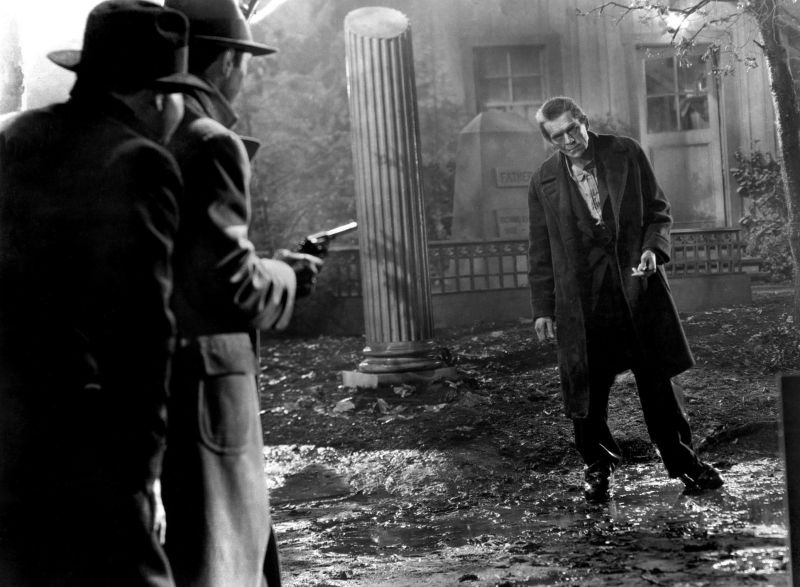
27 June 1954 - Cine S.Bento sometimes went as far back as the 1930s: 'Terra de ninguém' (Somewhere in Sonora) was a 1933 pre-Code western with a 26-year-old John Wayne; 'Morto ambulante' (The walking dead) was released in February 1936 with Boris Karloff now at Warner Brothers doing his usual thing; the most recent release in the programme was a 1953 Republic serial: 'Jungle drums of Africa' (Tambores feiticeiros) with Clayton Moore & Phillys Coates. Moore had played The Lone Ranger from 1949-1951 and as a TV series from 1954-1957.
Boris Karloff does 'The walking dead' in 1936.
John Wayne stick 'em up in Sonora in 1933.
Clayton Moore fights the witch doctor in Kenya in 1952.